From Broad Street (famous for all the bars and where President Clinton tasted his first pint) walk over Black Sabbath Bridge into Brindley Place with more bars and restaurants through to a central square where there are offices. As you walk into Brindley Place you will see the International Conference Centre (ICC) over the canal on the right. This walk takes you past Sea Life Centre. As you cross over the canal you will see the first residential to be built in Birmingham City Centre at the start of its renaissance in the late 1990’s. Walking back down the canal you turn into ICC and Symphony Hall. If you carried on walking down the canal, this would take you into Gas Street Basin and eventually The Mailbox. You can see The Cube in the distance. You end this first part of the walk on Centenary Square.
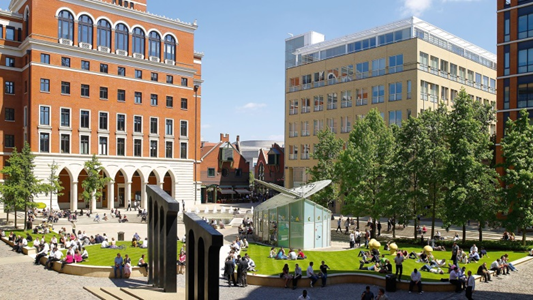
What is the character of this area?
What do you think about the public realm, use of open spaces and sense of place?
Has the developer been sensitive to the site’s heritage?
Background to Brindley Place
The name Brindley Place honors James Brindley, original engineer of the Birmingham Canal and many other waterways. Emerging from Gas Street Basin on to Broad Street, you are just five minutes from New Street Station and the Bullring. The surrounding area is a vibrant arts and entertainment area including the International Convention Centre, the National Indoor Arena, the Rep and much more.
Brindley Place is a mixed-use development built around three attractive public squares – Brunswick, Central and Oozells. Alongside this the estate includes The Water’s Edge, The Crescent Theatre, National Sea Life Centre and is positioned adjacent to Birmingham’s first city centre residential development, Symphony Court.
The area now occupied by Brindley Place was, at the height of Birmingham’s industrial past, the site of factories. By the 1970’s, however, as Britain’s manufacturing went into decline, the factories closed down and the buildings lay derelict for many years.
The development history of Brindley Place
This section might give you some idea of just how long a new development can take to build
- July 1987 Developers were invited by Birmingham City Council to draw up a blueprint for the vacant 26 acres of land adjacent to the International Convention Centre (ICC). The site was leased to a consortium of three companies; Merlin, Shearwater and Laing (MSL) who planned to create a ‘huge leisure and entertainment area’.
The Masterplan: MSL paid £23 million for the development rights; much of which was used to build the National Indoor Arena (NIA). Their proposal was for a £200 million development which included the NIA, a visitor led Festival Market (which was later shelved by Rosehaugh as being financially unviable) and National Aquarium.
- July 1990
Merlin pulled out of the scheme due to fears about the property slump and the project was taken
over by Shearwater’s parent company, Rosehaugh, which subsequently set up Brindley Place Pie as a subsidiary company to oversee the development.
- December 1991
Rosehaugh re-looked at the masterplan for the development and working with Birmingham City Council drew up a new exciting proposal for a high quality, mixed use development.
The development included 19 restaurants, shops and bars in Birmingham’s first ever purpose designed leisure venue overlooking the canals. The development proposals also contained 120 new homes to encourage more people to live in the city, rather than outside of it (this would become Symphony Court). There was 1,100,000 sq ft of offices, which would create 6,000 jobs. The leisure element was not absolutely certain but possible options at the time were Science of Sport, cinema, bowling alley. The existing Crescent Theatre was also to be rebuilt on Brindley place.
- July 1992
Outline planning permission was gained. This meant that the scheme would be implemented in phases and, led by market demand, employ 6,000 people on completion. It wasn’t all plain sailing… The obstacles had not only been financial, but ecological! In the recession, progress had been slow and Ecologists discovered that the site was home to a very rare Black Redstart; a bird which is a protected species. Work could not begin until the birds migrated.
- November 1992
Rosehaugh’s shares were suspended at 7.Sp where they had once traded at 925p. The company’s debts were reported to be at £350 million. After an anxious wait Brindley Place was declared to be safe and Brindley Place pie continued its work
- June 1993
Argent Group Pie, a privately owned UK property company, purchased Brindley Place for an undisclosed sum
The Official Launch: Workmen moved onto site on 6 September 1993 and the building project was launched on 29 September 1993. The first part of the development to be completed was The Water’s Edge – a canal side scheme of shops, restaurants and bars which was officially opened in November 1994.
Ownership: The majority of the Brindley Place estate is owned by Hines Global REIT, Inc. and Lone Star following the acquisition of eight buildings from The Brindley Place Limited Partnership in 2010. The
exceptions to this are Eleven Brindley Place, The Hilton Garden Inn Hotel, The National SEA LIFE Centre and finally The Water’s Edge element of Brindley Place which is owned by British Airways Pension Fund. The estate is managed as a whole by Bilfinger GVA’s Birmingham office which is based at Three Brindley Place.
Gas Street Basin
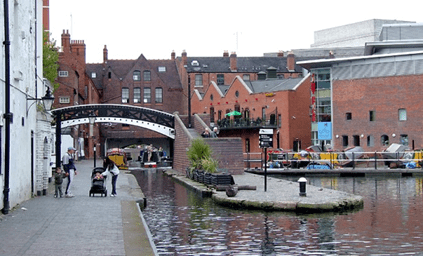
Gas Street Basin is the heart of Birmingham’s canal network. In days gone by it was the hub of a thriving canal transport network and would have been alive with the sound of cargoes as diverse as chocolate crumb, coal and glass being loaded and unloaded. Historically, Gas Street Basin was the meeting point of the Worcester & Birmingham Canal and the Birmingham Canal Main Line. Gas Street was the first street in the city to have gas lighting.
Today, the bars and restaurants of Brindley Place cluster around this attractive basin where traditional narrowboats and industrial heritage meets modern, cosmopolitan living.
The Cube
Located to the rear of the Mailbox is The Cube.
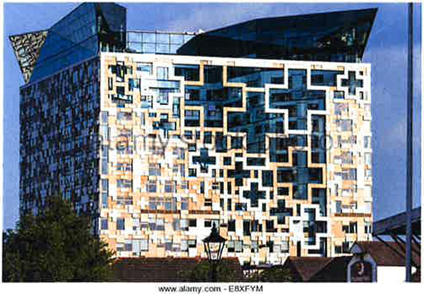
Designed by Ken Shuttleworth, Birmingham’s iconic landmark, The Cube is an outstanding 25-storey structure houses an impressive mix of prime office, retail and restaurant spaces, aspirational apartments, a boutique hotel, exclusive canal side restaurants, skyline champagne bar, luxury spa facilities, and the UK’s largest automated car park.
High profile names established at The Cube include Marco Pierre White’s Steakhouse Bar & Grill, The Club & Spa, Rodizio Rico Brazilian restaurant, Bun & Bowl burgers & shrimp, Shogun Teppanyaki, Madeleine fine coffee house and Hotel Indigo.
Perfectly situated in the heart of the city, The Cube is next to The Mailbox and a few minutes’ walks from the ICC, The Bullring, Brindleyplace and New Street Station.
The Mailbox
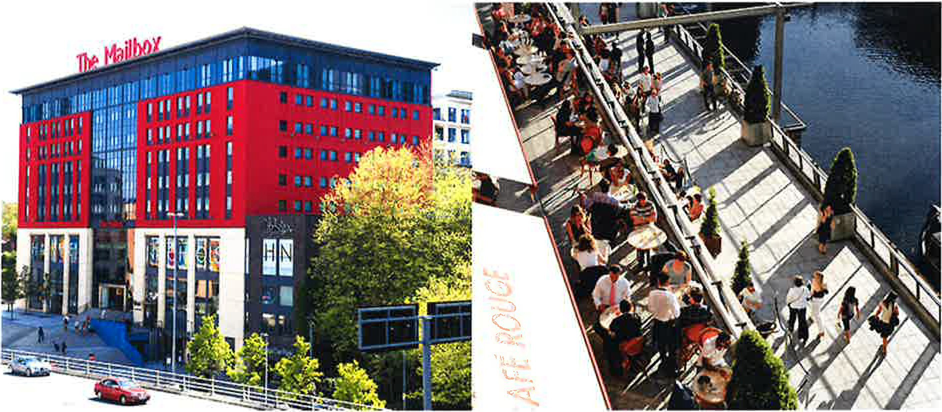
You’ll walk over the padlock bridge past The Cube and into The Mailbox.
Who is one of the main occupiers? Do you think that draws people into The Mailbox?
The Mailbox opened in 1998 and was the redevelopment of the former Royal Mail sorting office in Birmingham City Centre.
The Mailbox is one of the UK’s largest mixed-use buildings incorporating retail, leisure, offices and residential in a well-managed, security patrolled complex of the highest quality. Harvey Nicholls and designer stores blend in well with restaurants, leisure and apartments.
 School of the Built Environment Oxford Brookes